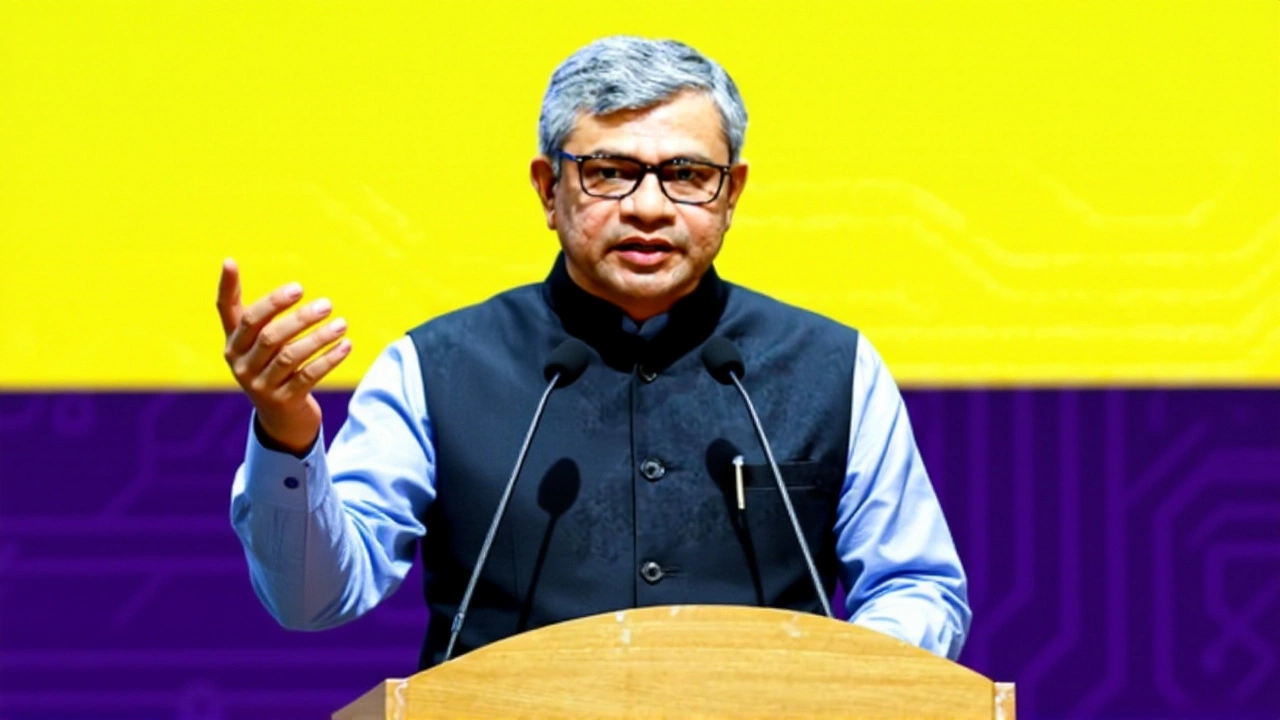
When Ashwini Vaishnaw, Union Minister for Electronics and Information Technology of Government of India, announced that electronics manufacturing has become India’s third-largest export category, the numbers told a story far bigger than just policy success. The sector has hit a record turnover of ₹13 lakh crore ($156 billion), signaling a massive shift in global supply chains.
This milestone wasn’t reached overnight. It happened during the inauguration of a state-of-the-art facility in Ranjangaon, Pune, Maharashtra, where Jabil, a major US-based electronics manufacturer, unveiled its new high-tech unit. But the real headline? India is no longer just an assembly line; it’s becoming a trusted global partner.
From Top 10 to Top 3: A Rapid Climb
Here’s the thing: when the ‘Make in India’ initiative launched on September 25, 2014, the goal was modest. The aim was simply to get electronics into the top 10 export categories. Turns out, they underestimated the momentum.
Vaishnaw outlined the steady climb: the sector moved from the 9th position to 7th, then 5th, 4th, and finally landed at 3rd. This isn’t just statistical noise; it reflects a structural change in what India sells to the world. While pharmaceuticals and gems remain staples, electronics are now driving significant foreign exchange earnings.
The twist is how fast this happened. In less than a decade, a sector once dominated by imports flipped to become a net exporter powerhouse. This trajectory mirrors the early days of Vietnam’s rise but with a much larger domestic market backing it up.
Policy Push: PLI Schemes Take Center Stage
Behind these numbers lies a aggressive fiscal strategy. The government didn’t just hope for growth; it bought it with incentives. The Production Linked Incentive (PLI) scheme has been the engine room of this transformation.
Look at the budget allocations. For the fiscal year 2024-25, the revised estimate for electronics under PLI was ₹5,747 crore. Fast forward to 2025-26, and that figure jumps to ₹8,885 crore. That’s an increase of ₹3,138 crore, or roughly 54.6%. Why the hike? Because the ROI is clear. Every rupee spent on incentives is generating multiple rupees in output and exports.
But wait, there’s more. The Press Information Bureau noted that these schemes aren’t isolated. They’re part of a broader ecosystem overhaul involving easier licensing, digital tracking systems, and reduced red tape. It’s about making it easier to do business than anywhere else in the region.

Global Giants Bet Big on India
You can’t talk about this boom without mentioning the big names jumping on board. It’s not just domestic players; global titans are restructuring their operations around India.
Foxconn, the Taiwanese manufacturing giant behind Apple’s iPhones, plans to invest up to $500 million in Bengaluru for smartphone accessories. With existing investments, Foxconn’s total commitment in Karnataka hits $2.7 billion. Then there’s Panasonic Electric Works India, which announced a ₹3,000 crore expansion in Sri City, Andhra Pradesh, back in September 2023.
Even tech behemoth Google LLC is in the mix. They’ve confirmed local production of the Pixel 8 smartphone and Chromebooks in partnership with HP. This signals confidence in India’s ability to handle complex, high-value manufacturing, not just low-cost assembly.
The Bigger Picture: GDP and Jobs
Why does this matter to you? Because manufacturing drives jobs. The original ‘Make in India’ vision aimed to boost manufacturing’s share in GDP from 16% to 25% and create 100 million additional jobs by 2022. While the job target timeline shifted, the economic impact is undeniable.
Currently, manufacturing contributes about 15% to India’s GDP. The push is to close that gap. Electronics are leading the charge because they have high value-addition and strong backward linkages. When a phone is made here, it pulls in demand for components, packaging, logistics, and software services.
Narendra Modi, India’s Prime Minister, has consistently framed this as a long-term structural reform. Vaishnaw credited Modi’s foresight for creating the policy stability needed for such large-scale industrial shifts. It’s a rare alignment of political will and corporate execution.

What’s Next for Indian Electronics?
The details are still evolving, but the direction is clear. India is positioning itself as a reliable alternative to China in the global supply chain. Diversification is the keyword for multinational corporations right now.
Expect more announcements in semiconductors and display manufacturing, areas where India is currently lagging but investing heavily. The Ranjangaon unit inaugurated by Vaishnaw and Maharashtra Deputy Chief Minister Devendra Fadnavis is just one node in a growing network. As infrastructure improves and skilled labor pools expand, the cost competitiveness will only sharpen.
The challenge remains scaling up component manufacturing. Right now, many parts are still imported. But with the PLI scheme expanding to advanced chemistry cell batteries and other inputs, that dependency should shrink over the next five years.
Frequently Asked Questions
How did electronics become India's third-largest export category?
Through the 'Make in India' initiative launched in 2014, supported by Production Linked Incentives (PLI). The sector climbed from the 9th to the 3rd spot by attracting global manufacturers like Foxconn and Jabil, boosting domestic production capacity significantly.
What is the current size of India's electronics manufacturing sector?
The sector has reached a record turnover of ₹13 lakh crore (approximately $156 billion). This represents a massive surge in output value, driven by both domestic consumption and rising export volumes.
Which global companies are investing in India's electronics sector?
Major players include Foxconn (investing $500 million in Bengaluru), Panasonic (expanding in Andhra Pradesh), Google (manufacturing Pixel phones locally), and Jabil (inaugurating a new unit in Pune). These firms are diversifying supply chains away from single-source dependencies.
How much funding is allocated for electronics under the PLI scheme?
For the fiscal year 2025-26, the allocation is ₹8,885 crore, a significant increase from ₹5,747 crore in 2024-25. This 54.6% rise highlights the government's commitment to sustaining growth in high-value manufacturing.
What role did Prime Minister Narendra Modi play in this growth?
Minister Ashwini Vaishnaw credited PM Modi's long-term vision and the 'Make in India' framework for creating the policy environment that attracted foreign investment and streamlined regulatory processes for manufacturers.